good question, now that i have a petrol fronty this concerns me.
i have driven through quite deep flooding in the highlands but it has been in my diesel vauxhall dang goods veh, or my last motor, no second thoughts

driving through water.
22 posts
• Page 1 of 2 • 1, 2
driving through water.
by Silver Ghost on Fri Dec 14, 2007 10:12 pm
- Silver Ghost
- frontera God

- Posts: 779
- Joined: Thu Mar 22, 2007 7:41 pm
- Model: 2.2i 5dr
- Registration Year: 1999/S
- Region: South East
by slapshotDTSneil on Fri Dec 14, 2007 11:03 pm
- slapshotDTSneil
- Mole
- Posts: 587
- Joined: Sun Dec 02, 2007 12:35 am
by UGE on Fri Dec 14, 2007 11:10 pm
First thing CHECK THE DEPTH if it is a ford there sometimes is a water level board to give you a rough idea if there is not and you can get to the middle (if there is a bridge) test the depth with a stick (if you go to a fishing shop pick up a long "canal" bank stick that is extendable). Keep the air intake above water (snorkel or intake mod with pope in the engine bay) or if you have a decent bow wave going you should be ok.
The exhaust is fine to go underwater, i would recomend keeping your revs up though if you are unsure. if your car is petrol then take care the bow wave is importent however if its a diesel then the engine can go under water.
This is what i normaly do if going through a ford
1) Select 4x4 low
2) Enter the water slow for about 3-4ft, By now there should be a bow wave infront of the car.
3) Try to match the speed of the bow wave as best you can without going over 10mph and if you need to ride your clutch a little bit to keep your revs up,
4) Once out on the other side CHECK YOUR BREAKS.
5) If on a road change back to 2wheel high, if not keep in 4x4 high or low and carry on the fun
One thing though if you have been driving for a long distence be carefull as the shock of cold water to a hot wheel bairing or engine can/could make them crack.
I have not taken my frontie deeper than 2ft yet as not long had it but took my 1.6 petrol vitara through a ford where the water was about 3-3.5ft deep
IF IN DOUBT DO NOT ATTEMPT.
The exhaust is fine to go underwater, i would recomend keeping your revs up though if you are unsure. if your car is petrol then take care the bow wave is importent however if its a diesel then the engine can go under water.
This is what i normaly do if going through a ford
1) Select 4x4 low
2) Enter the water slow for about 3-4ft, By now there should be a bow wave infront of the car.
3) Try to match the speed of the bow wave as best you can without going over 10mph and if you need to ride your clutch a little bit to keep your revs up,
4) Once out on the other side CHECK YOUR BREAKS.
5) If on a road change back to 2wheel high, if not keep in 4x4 high or low and carry on the fun
One thing though if you have been driving for a long distence be carefull as the shock of cold water to a hot wheel bairing or engine can/could make them crack.
I have not taken my frontie deeper than 2ft yet as not long had it but took my 1.6 petrol vitara through a ford where the water was about 3-3.5ft deep
IF IN DOUBT DO NOT ATTEMPT.
Last edited by UGE on Fri Dec 14, 2007 11:48 pm, edited 2 times in total.
Ewan
2.8lt TD M reg
Member Of TORRO
2.8lt TD M reg
Member Of TORRO
-
UGE - my other cars a frontera

- Posts: 227
- Joined: Sun Nov 18, 2007 7:31 pm
- Location: Leicester
- Model: 2.8 TDI 5dr
- Registration Year: 1995/M
- Modifications: only a K&N for now
- Region: Midlands
by Alpine_Skier_UK on Fri Dec 14, 2007 11:26 pm
I always thought it was "BOW Wave" not "BOWL Wave"!!!
As in Bow... the front of a boat!!!!

As in Bow... the front of a boat!!!!
-

Alpine_Skier_UK - Apprentice Frontera engineer
- Posts: 81
- Joined: Tue Mar 07, 2006 11:29 pm
- Location: Huddersfield West Yorkshire
by Red Oktober on Fri Dec 14, 2007 11:27 pm
Very good advise there Uge
just one other point to make ........Don't follow me

If your engine does happen to stall ....DO NOT TRY RE-STARTING
i have taken my 2.8tdi LWB through 3.5-4ft of water .....but then i do have a snorkel
the single most important peice of advise to anyone is ...
..............IF IN DOUBT DO NOT ATTEMPT IT.................
just one other point to make ........Don't follow me
If your engine does happen to stall ....DO NOT TRY RE-STARTING
i have taken my 2.8tdi LWB through 3.5-4ft of water .....but then i do have a snorkel
the single most important peice of advise to anyone is ...
..............IF IN DOUBT DO NOT ATTEMPT IT.................
- Red Oktober
- Retired
- Posts: 11919
- Joined: Wed Feb 08, 2006 8:59 pm
- Model: 2.8 TDI 5dr
- Registration Year: 1995/N
- Region: South West
by outergods on Fri Dec 14, 2007 11:32 pm
Rule of thumb on an unprepared vehicle is not deeper than the wheel hubs.
the dangers of running in water, and more so for muddy water is the removal of lubrication from moving parts, and the contamination of joints and brakes.
if you intend to play in water, be prepared to do more maintenance.
muddy water will grind away brake pads, especially on drum brakes, and it will act as a grinding paste on any moving part.
Ok, horror story over.
Wading:
The Exhaust can be submerged, completely. as long as the engine is running the exhaust gasses will force the water out. Expect comedy gurgling noises.
The air intake MUST remain above water. Competely above. Hence SNORKELS.
If the engine sucks water it will hydraulic, also know as hydro lock. this is when the cylinders fill with water and the engine locks up due to water not compressing like air can. if your lucky, you pull the plugs and crank it and it clears, if you arent you blow gaskets etc. so watch your intake point.
When wading approach the obsicle at a steady speed, and maintain speed through the water. this will build a bow wave at the nose and create a false low in the engine bay. the bow wave should not brake over the bonnet, if it does, slow down. If the wave dissipates, speed up.
Ive run my old 2.4i fronty through a 2 foot deep fast ford (with a group of other 4x4's, not alone) and suffered no ill effects.
Start small, on puddles and runs you know the depth and lay of, and build from there.

Matt
the dangers of running in water, and more so for muddy water is the removal of lubrication from moving parts, and the contamination of joints and brakes.
if you intend to play in water, be prepared to do more maintenance.
muddy water will grind away brake pads, especially on drum brakes, and it will act as a grinding paste on any moving part.
Ok, horror story over.
Wading:
The Exhaust can be submerged, completely. as long as the engine is running the exhaust gasses will force the water out. Expect comedy gurgling noises.
The air intake MUST remain above water. Competely above. Hence SNORKELS.
If the engine sucks water it will hydraulic, also know as hydro lock. this is when the cylinders fill with water and the engine locks up due to water not compressing like air can. if your lucky, you pull the plugs and crank it and it clears, if you arent you blow gaskets etc. so watch your intake point.
When wading approach the obsicle at a steady speed, and maintain speed through the water. this will build a bow wave at the nose and create a false low in the engine bay. the bow wave should not brake over the bonnet, if it does, slow down. If the wave dissipates, speed up.
Ive run my old 2.4i fronty through a 2 foot deep fast ford (with a group of other 4x4's, not alone) and suffered no ill effects.
Start small, on puddles and runs you know the depth and lay of, and build from there.
Matt
2.8TDI Sport. - 3" lift, 31" Recip Trials, Roof Rack, High Lift, Winch.
-

outergods - my other cars a frontera
- Posts: 283
- Joined: Wed Oct 19, 2005 2:36 pm
- Location: Durham
by UGE on Fri Dec 14, 2007 11:52 pm
Ewan
2.8lt TD M reg
Member Of TORRO
2.8lt TD M reg
Member Of TORRO
-
UGE - my other cars a frontera
- Posts: 227
- Joined: Sun Nov 18, 2007 7:31 pm
- Location: Leicester
- Model: 2.8 TDI 5dr
- Registration Year: 1995/M
- Modifications: only a K&N for now
- Region: Midlands
by marlbororman on Sat Dec 15, 2007 12:20 am
Ian
---------------------------------------------------
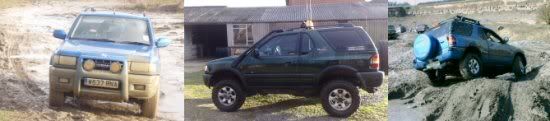
2.2rs sport Green 3"suspension lift, 3"Body lift,Safari Snorkel,32" mt`s,Car Pc running the tunes + Gps and other things :)
:)
Member no. 705
http://www.humber-yorks4x4response.org.uk
---------------------------------------------------
2.2rs sport Green 3"suspension lift, 3"Body lift,Safari Snorkel,32" mt`s,Car Pc running the tunes + Gps and other things
:)Member no. 705
http://www.humber-yorks4x4response.org.uk
-

marlbororman - Lord frontera
- Posts: 1091
- Joined: Sun Aug 13, 2006 8:48 am
- Location: Hull
by alex on Sat Dec 15, 2007 10:38 am
My 3.2 went through Corwen happy, it does add to the scare in a petrol.
I might add a little,
If you havent had the car long or are un aquainted to it mechanicaly.
Its worth checking the inner arch is secured, this stops water washing into the airbox and engine bay as the wheels wash it up.
Its also worth slipping some grease over various points and plugs etc to stop ingress of water.
Also the rad, make sure its fairly secure, rushing water can push a loose one into the fan (not good)
If your new dont go alone, you wont push a stalled car from water theres always a bank somewhere to climb.
If not attaching a recovery strap think about where one can go front and rear, even feel around down there while standing as in murky water you wont see whats happening.
Water and mud is great fun, there are loads of us about to show you around, if in doubt try and get in on a day out maybe even as a passenger to get a feel of what these beasts can do.
I might add a little,
If you havent had the car long or are un aquainted to it mechanicaly.
Its worth checking the inner arch is secured, this stops water washing into the airbox and engine bay as the wheels wash it up.
Its also worth slipping some grease over various points and plugs etc to stop ingress of water.
Also the rad, make sure its fairly secure, rushing water can push a loose one into the fan (not good)
If your new dont go alone, you wont push a stalled car from water theres always a bank somewhere to climb.
If not attaching a recovery strap think about where one can go front and rear, even feel around down there while standing as in murky water you wont see whats happening.
Water and mud is great fun, there are loads of us about to show you around, if in doubt try and get in on a day out maybe even as a passenger to get a feel of what these beasts can do.
Fronty no.4, pimp mobile Treg 3.2 LWB lifted 2.5"
Fronty no.5 2.8 swb hd coils +2" 31"machos.
Fronty no.5 2.8 swb hd coils +2" 31"machos.
-

alex - The Battering Ram
- Posts: 4625
- Joined: Wed Mar 14, 2007 4:18 pm
- Model: 3.2 V6 5dr
- Registration Year: 1999/T
- Modifications: 3.2v6 LWB lifted on 31"at's "The Pimp mobile"
2.8 LWB
5" supension lift,
Body lift,
Manual hubs,
33" mudders,
Fixed Flywheel,
B&Q snorkle,
Flipped ball joints,
Procomp steering shocker,
Modified front bump stops,
Exhaust recirc removed,
EGR removed,
Cat removed,
Front diff lowered,
Dislocation cones,
Spring retainers,
Buckets 4 point harness,
The biggest cb twig you can get.
"The Beast" - Region: Midlands
by KJA on Sat Dec 15, 2007 1:14 pm
A word of caution, diesel engines are far more likely to be damaged if water enters the air intake than a petrol. This is because the compression ratio is so much higher.
A few years ago I waded a V8 RR in a 'bomb hole' that was far too deep and it ingested water. Took all the plugs out and turned engine over with vast amounts of mucky water coming out the exhaust, cleaned up air intake and it ran no probs. I tried the same thing in a Mazda SL engined RR and it caused catastrophic damage, it bent con rods!
The other thing is that the V8 RR being auto the transmission slips at low speeds, so if the engine stops, the forward momentum of the car doesn't force the engine to turn over, whereas with a manual it will.
The only water proofing the RR needed for wading up to the bonnet line was a few squirts of silicone on the dissy, HT leads coil etc.
If in doubt don't do it!!!
A few years ago I waded a V8 RR in a 'bomb hole' that was far too deep and it ingested water. Took all the plugs out and turned engine over with vast amounts of mucky water coming out the exhaust, cleaned up air intake and it ran no probs. I tried the same thing in a Mazda SL engined RR and it caused catastrophic damage, it bent con rods!
The other thing is that the V8 RR being auto the transmission slips at low speeds, so if the engine stops, the forward momentum of the car doesn't force the engine to turn over, whereas with a manual it will.
The only water proofing the RR needed for wading up to the bonnet line was a few squirts of silicone on the dissy, HT leads coil etc.
If in doubt don't do it!!!
- KJA
- my other cars a frontera
- Posts: 220
- Joined: Thu Jan 25, 2007 10:26 pm
- Location: Sherborne, Dorset
- Region: South West
by Red Oktober on Sat Dec 15, 2007 1:23 pm
- Red Oktober
- Retired
- Posts: 11919
- Joined: Wed Feb 08, 2006 8:59 pm
- Model: 2.8 TDI 5dr
- Registration Year: 1995/N
- Region: South West
by Drift on Sat Dec 15, 2007 3:26 pm
All good advice above.
This is Carl's engine hydraulicked earlier this year.
Courtesy of Trugga
http://uk.youtube.com/watch?v=bf9WKyVokPw
As im not keen on a snorkel at the moment Ive made a little air intake mod to give a little extra insusurance.


As I believe the original air intake on the fromtera is in the most stupidest of places under the wheel arch
This is Carl's engine hydraulicked earlier this year.
Courtesy of Trugga
http://uk.youtube.com/watch?v=bf9WKyVokPw
As im not keen on a snorkel at the moment Ive made a little air intake mod to give a little extra insusurance.
As I believe the original air intake on the fromtera is in the most stupidest of places under the wheel arch
Ste
FOG Administrator
Frontera Technical Support
Often Imitated Never Bettered
http://www.fronteraowners.co.uk

Its here, the FOG Annual Meet 2014 viewforum.php?f=123
FOG Administrator
Frontera Technical Support
Often Imitated Never Bettered
http://www.fronteraowners.co.uk
Its here, the FOG Annual Meet 2014 viewforum.php?f=123
-

Drift - The Man-ual

- Posts: 43955
- Joined: Tue Dec 06, 2005 11:20 pm
- Location: Driftshire
- Model: 2.8 TDI 5dr
- Registration Year: 1995/N
- Vehicle Name: Daddy's Car or Triggers Broom
- Modifications: 2.8 TDI LWB
Tinkered to it's practical limits but understated, though shockingly cool (do you know her?).
She is nicccccceeee ;-) - Region: North West
- Skype Username: driftwood10
by Red Oktober on Sat Dec 15, 2007 4:25 pm
heres where your air intake is ......(just in front of that black box thing)

- Red Oktober
- Retired
- Posts: 11919
- Joined: Wed Feb 08, 2006 8:59 pm
- Model: 2.8 TDI 5dr
- Registration Year: 1995/N
- Region: South West
by lee thompson on Sat Dec 15, 2007 8:52 pm
position of air intake on all fronteras?
opel frontera lwb 16v 2.2 petrol...punctuation is important for example."i once helped my uncle jack off a horse"
-

lee thompson - my other cars a frontera
- Posts: 285
- Joined: Tue Mar 06, 2007 5:27 pm
- Location: northampton!!!!!
by Red Oktober on Sat Dec 15, 2007 8:54 pm
- Red Oktober
- Retired
- Posts: 11919
- Joined: Wed Feb 08, 2006 8:59 pm
- Model: 2.8 TDI 5dr
- Registration Year: 1995/N
- Region: South West
by lee thompson on Sat Dec 15, 2007 8:58 pm
opel frontera lwb 16v 2.2 petrol...punctuation is important for example."i once helped my uncle jack off a horse"
-
lee thompson - my other cars a frontera
- Posts: 285
- Joined: Tue Mar 06, 2007 5:27 pm
- Location: northampton!!!!!
by Red Oktober on Sat Dec 15, 2007 9:00 pm
No worries Lee
- Red Oktober
- Retired
- Posts: 11919
- Joined: Wed Feb 08, 2006 8:59 pm
- Model: 2.8 TDI 5dr
- Registration Year: 1995/N
- Region: South West
by Silver Ghost on Sat Dec 15, 2007 9:57 pm
so, is it the air intake that you have to watch, or the exhaust, which was my original question, for us newbies to that sort of thing.
sean
sean
- Silver Ghost
- frontera God
- Posts: 779
- Joined: Thu Mar 22, 2007 7:41 pm
- Model: 2.2i 5dr
- Registration Year: 1999/S
- Region: South East
by Red Oktober on Sat Dec 15, 2007 9:59 pm
it's the air intake you have got to keep out of the water 
- Red Oktober
- Retired
- Posts: 11919
- Joined: Wed Feb 08, 2006 8:59 pm
- Model: 2.8 TDI 5dr
- Registration Year: 1995/N
- Region: South West
by Drift on Sat Dec 15, 2007 10:06 pm
Ste
FOG Administrator
Frontera Technical Support
Often Imitated Never Bettered
http://www.fronteraowners.co.uk
Its here, the FOG Annual Meet 2014 viewforum.php?f=123
FOG Administrator
Frontera Technical Support
Often Imitated Never Bettered
http://www.fronteraowners.co.uk
Its here, the FOG Annual Meet 2014 viewforum.php?f=123
-
Drift - The Man-ual
- Posts: 43955
- Joined: Tue Dec 06, 2005 11:20 pm
- Location: Driftshire
- Model: 2.8 TDI 5dr
- Registration Year: 1995/N
- Vehicle Name: Daddy's Car or Triggers Broom
- Modifications: 2.8 TDI LWB
Tinkered to it's practical limits but understated, though shockingly cool (do you know her?).
She is nicccccceeee ;-) - Region: North West
- Skype Username: driftwood10
22 posts
• Page 1 of 2 • 1, 2
Who is online
Users browsing this forum: No registered users and 30 guests